
There is a point in almost every truly bad call where your brain takes a second to acknowledge what has just been placed in front of you.
Mine usually sounds something like:
“OH. So THIS is what we have today, is it?”
It isn’t panic, exactly. It isn’t calm either. It’s more like my brain needs one sarcastic sentence to formally accept that reality has once again become ridiculous.
Then we move on.
A few years ago, working as a shift captain, I watched a new paramedic learn this lesson in real time.
He had not been a medic very long. I don’t remember exactly how long, but this was one of his first real calls after getting his patch. He was working with a much more experienced medic.
We’ll call the patient Bob.
Bob was a contractor working in the area, and Bob had decided that particular day would be an excellent time to have an absolutely enormous STEMI.
Not a subtle one.
Not one of those ECGs where everybody stands around squinting at a millimeter here and some reciprocal changes there, debating whether the morphology is concerning enough to activate.
No.
We were still carrying LP15s at the time, and this thing might as well have printed:
WHY ARE YOU EVEN READING THIS TEXT, YOU FUCKING IDIOT?
It was an absolutely hideous anterolateral STEMI.
And everybody was suddenly looking at the new medic.
I remember watching him because I knew exactly where he was professionally. New medic. New responsibility. First time the universe had handed him something where the answer was not “ask the medic.”
He was the medic.
He was sweating bullets.
I could see the panic in his eyes.
But if you had only been listening to him, you wouldn’t have known it.
His voice was controlled. He was directing the call. He knew what needed to happen. He got the 12-lead, recognized what he was looking at, started getting Bob packaged, and kept the call moving.
Every so often I’d ask him:
“Need anything else?”
And he’d give me something to do, or tell me he was good, and keep going.
I didn’t take over.
He didn’t need me to.
He needed another experienced person standing nearby who could grab something, fix something, or catch him if the wheels came off.
The wheels never came off.
Meanwhile, the experienced medic was very concerned with demographics.
Or an address.
Or paperwork.
I honestly don’t remember.
I just remember thinking something along the lines of:
Get the fucking 12-lead. Secure the patient. Put him in the fucking truck. DRIVE.
Bob’s ZIP code would still be there at 70 miles per hour.
His coronary artery was considerably less patient.
That call eventually became something of a legend. We set what, at least at the time, we were told was a record patient-contact-to-balloon time for a rural patient in that STEMI system. The receiving hospital gave us a challenge coin afterward that I still have.
Bob survived.
But what stuck with me from that call wasn’t the STEMI, the record, or the challenge coin.
It was the new medic.
Because he taught me something I don’t think we do a particularly good job teaching new EMTs, paramedics, dispatchers, supervisors, or really anybody who is expected to function when things go sideways.
He was not calm.
He was functioning while scared shitless.
Those are not the same thing.
We tell people to “remain calm.”
It’s bullshit advice.
Nobody has ever looked at a horrific car wreck, a dying kid, a massive STEMI, a working code, an active threat, or any of the thousand other ways a normal Tuesday can suddenly become profoundly abnormal and thought:
“Oh, right. My instructor told me to remain calm.”
Stress is going to happen.
Your sympathetic nervous system does not particularly care what was written in the PowerPoint.
The useful skill isn’t learning how to prevent the OH FUCK response.
It’s learning what comes immediately afterward.
For me, apparently, that starts with sarcasm.
“OH. So THIS is what we have today, is it?”
Fine.
What do I have?
What can kill somebody first?
What needs to happen now?
What can wait?
Do step one.
Reassess.
Go to step two.
That’s it.
Marina has told me before that I am unnaturally calm when something bad happens.
I’m really not.
I’ve just been doing this long enough that most of the screaming happens on a private radio channel.
Externally, I am looking at the problem, figuring out what needs to happen, and doing it.
Internally, there is another guy standing there with a clipboard saying:
“Sure. Of course there’s a fucking car in the living room. Why wouldn’t there be? Anyway, step two.”
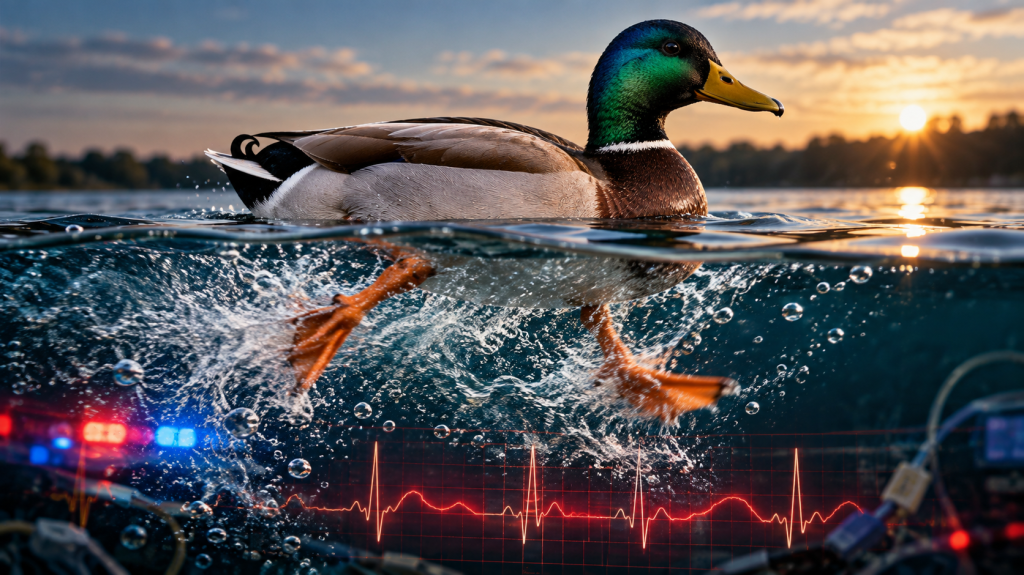
I think of it as the EMS duck.
On the surface, the duck is just cruising along.
Underneath, those little bastard feet are going like hell.
Early in your career, they’re going REALLY fucking fast.
That’s okay.
Everybody paddles.
The mistake is believing that expertise means eventually you stop paddling altogether.
I don’t think you do.
The paddling gets more efficient. You waste less movement. You recognize problems faster. You have frameworks to fall back on. You’ve seen enough disasters that your brain has a reasonably organized filing cabinet of previous disasters to consult.
And sometimes you’ve seen absolutely nothing like what is standing in front of you.
That’s when the little voice comes back.
“OH. So THIS is what we have today, is it?”
The difference is that experience gives you somewhere to go from there.
Maybe that’s what “calm under pressure” actually is.
Not the absence of fear.
Not some superhuman ability to look at catastrophe and feel nothing.
Not pretending you aren’t overwhelmed.
It’s retaining enough control over your brain to ask the next useful question.
Then answering it.
Then asking the next one.
Watching that new medic that day, I could see the duck’s feet.
He was fucking terrified.
But the patient couldn’t.
The crew didn’t need to.
What they got was a paramedic recognizing a life-threatening emergency, setting priorities, communicating, and moving the patient toward definitive care.
And what that new medic got was something even more important than a good STEMI save.
He got proof that he could be scared and still be good at his job.
I think that’s a lesson worth teaching.
Because sooner or later, everybody gets handed a call that makes their brain say:
“Oh, fuck.”
The goal isn’t to stop that moment from happening.
The goal is to know what happens next.

