The call wasn’t anything major. Two-car MVC, minor entrapment, a couple door pops, patients removed, scooped out and moved into the waiting ambulances. We handled it without mutual aid from neighboring counties. One volunteer fire department assisted. City and County law enforcement on scene directing traffic.
My role was pretty simple: head on a swivel, count patients, count crews, make sure nobody steps outside the traffic cones, make sure nobody drives inside them, ensure all patients get triaged and transported or get a signed refusal before we leave. Communicate with dispatch. Remain calm. Like a duck on the water—calm on the surface, paddling like mad underneath.
Two weeks ago, during what I thought would be a routine telepsychiatry appointment, Monalisa told me something I wasn’t prepared to hear.
Our next appointment would be our last.
We were reviewing how the medications were doing. A recent increase in Effexor had helped resolve a brief resurgence of depressive symptoms that had begun to interfere with my quality of life. Because of the dose change, we had returned to meeting every couple of weeks.
We talked about life more broadly—how the boys were doing, how work was going, and how things felt surprisingly stable for now, even with a major move to Chicago looming a few months down the road.
My first real job out of college wasn’t in medicine, or anywhere near an ambulance. It was in lighting — the kind that makes concerts glow, trade shows sparkle, and corporate galas look like the Grammys. The company was called On Location Lighting Systems, or OLLS, based out of northern Kentucky just south of Cincinnati.
That place was equal parts magic and madness. The shop always smelled like sawdust, gaff tape, and dust from road cases that had been halfway around the country. I was mostly broke — just out of school, living mostly on PB&Js, takeout food, and overtime — but for the first time, I felt like I was part of something creative. I was the shop manager, which meant I handled all the rental gear going out and coming back in, did minor repairs, kept the chaos somewhat organized, and still found myself out on shows and short tours whenever they needed an extra pair of hands.
When I wrote A Mental Health Odyssey, I honestly didn’t know what would happen. Hitting “publish” felt a little like standing naked in the middle of traffic — raw, exposed, and bracing for impact. I wasn’t sure if anyone would read it. I wasn’t sure if anyone would care. And if they did care, I half-expected whispers, judgment, or polite distance.
What I got instead was the opposite. Messages from colleagues in EMS who admitted they’d been in the same hole. Supervisors who could have looked the other way, but didn’t. Members of Marina’s congregation who reached out with warmth I didn’t see coming. Even people I barely knew told me they saw themselves in my words. It felt like people started handing me candles in the dark, one by one, until the room didn’t look so terrifying anymore.
I’ve written before about my struggles with mental health. I’m diagnosed with major depressive disorder, generalized anxiety disorder, and social phobia. Many are surprised to learn this about me in contrast with my chosen profession of EMS, where I am routinely confronted with high-stress situations and interfacing with the public and unknown groups of people on a regular basis. At baseline, I’m a pretty easy-going guy. Through a combination of a lifetime of therapy and the right medications, I am able to live a happy life, and function well at work, providing professional, courteous care to my patients, and working well with my peers and supervisors. Over the past year and a half or so, I lived and worked through some very difficult changes in my mental health. They affected me, my family, my work life, my home life, everything around me changed as a result. I am writing this (very long) blog post to share my journey into, through, and out of one of the worst times of my life.
Please be forewarned that I share very personal information and thought processes, some medical information, and thoughts pertaining to suicidality/self-harm in this post.
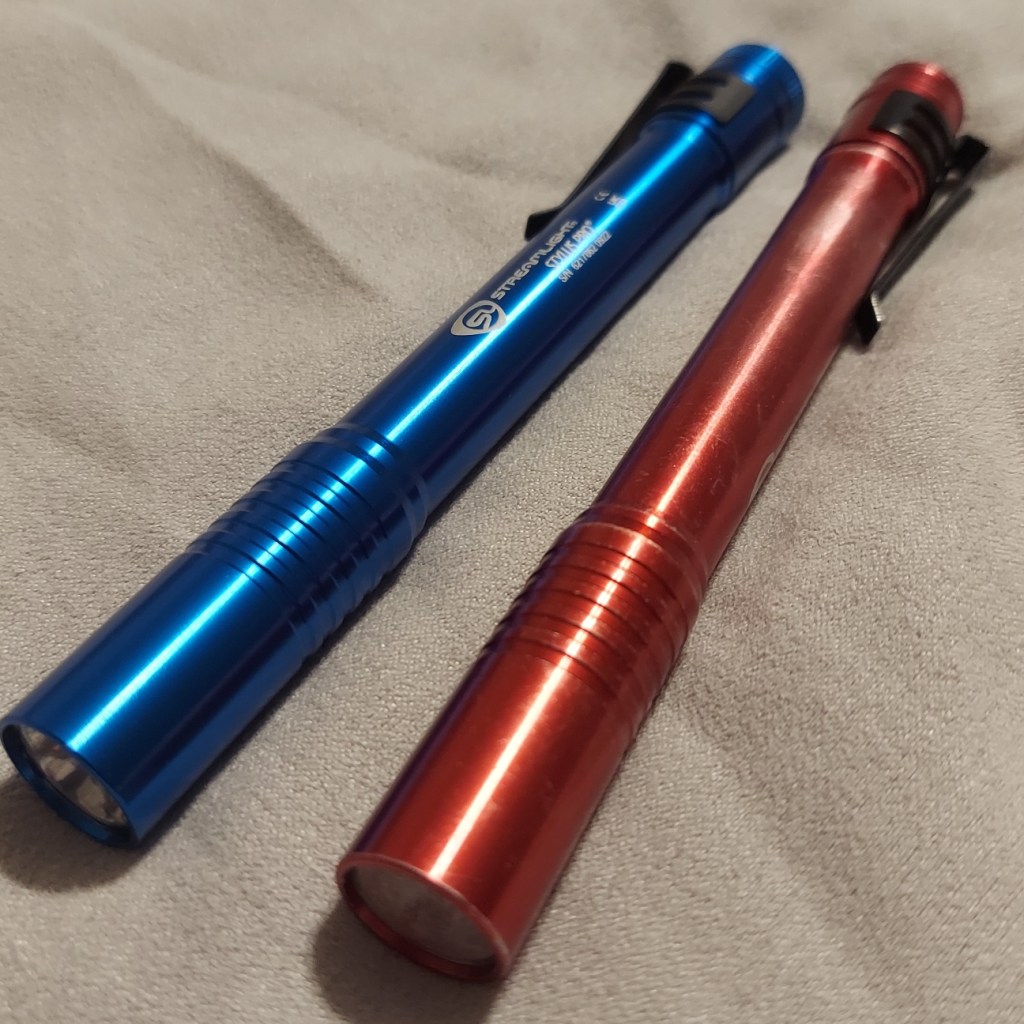
Out with the old, and in with the new, they say, right? It’s a small thing, but the red penlight on the right has been with me for the better part of 15 years. I think it maybe was a gift when I graduated from paramedic school. It’s been in my sleeve pocket or shirt pocket on literallyevery single EMS call I’ve gone on since then, and has assisted me with assessing thousands of patients. It recently started malfunctioning, and despite having survived several trips through the wash, untold rolls under the stretcher wheels, drops down stairs, and being forgotten in ambulance footwells, patient homes, and on sidewalks, somehow it always managed to find its way back to me. Tonight it finally gave up the ghost, and I replaced it with a new blue one of the same model, a Streamlight Stylus Pro. (why in the world would I look for a new model after such good service from the original?)
I know many of my colleagues trust the disposable penlights handed out by the service they work for, but there’s something meaningful and tangible to me of having my own diagnostic tools available and at the ready. I think my wife rolled her eyes a little when I expressed some sadness at the idea of moving on from ol trusty rusty here, and I get it. It is, after all, just a thing, an inanimate object that I have assigned meaning to over the years. It has no feelings or thoughts and won’t know that I have replaced it with a cleaner, shinier, better-working version of itself. And yet…. there’s a tiny part of me that will miss ol’ red, it won’t be the same penlight I’ve had for all these years in my pocket. There’s something to be said for consistency, and I find great comfort in it. Anyway, can’t help patients with a broken penlight, so I must move forward and start another 15 year adventure with blue here, and see what kind of trouble we can get ourselves into!
Thanks for reading my ramblings. If you got this far… are there any tools or gadgets you hold on to despite their obvious replace-ability?
My wife joined my life journey unexpectedly, and has remained a steadfast and constant source of compassion and comfort.
I’ve been thinking a lot lately about how people move in and out of my life. Quickly. Slowly. Suddenly and abruptly. Gradually or almost without noticing. The amount of time they spend in my life, in my physical presence seems completely unrelated to the amount of time they remain in my conscious and subconscious mind for days, weeks, and years after we part ways. Did they become a part of my life because I was born into a family they were already a key part of, as with my Gramma, and so I never knew a world without her as I grew up, forming every early memory and becoming the person I am today with so many of her fingerprints all over my way of thinking, of being, how I interact with people, how I think about the world around me? Or were they a coworker who became like a family member to me, a brother or sister, who I could trust with my life in a heartbeat, and who would trust me with theirs just the same? Were they a patient? Brought into my life by maybe the worst part of theirs, expecting me to solve their most dire problem at a moment’s notice, together for perhaps only minutes or an hour, and gone again just as fast.
Throughout my EMS career, I’ve often wondered why a certain subset of people call 911 so often. Seemingly minor concerns are blown way out of proportion, and, throwing logic and reason to the wind, they demand that the patient be taken to a specialty ER for examination by a specially trained physician.
Who are these people? What subset of the patient population could I be referring to?
You know that song by Faces, Ooh La La, that has the chorus that goes “I wish that I knew what I know now, when I was younger“? That’s how I feel about some parts of my career in EMS. I realized today that I’m about 12 years into my EMS career, and about 7 of those years spent working full-time in EMS. A decade or so of working in public service has shown me a lot of amazing things. I’ve seen people cause each other great pain and harm, and I’ve seen the truly amazing side of humanity – people coming together to help total strangers on their worst day. I’ve responded to MVCs, fires, overdoses, cardiac arrests, asthma attacks, heart attacks, strokes, a wildfire, floods, a tornado, and more falls than I can count. I’ve worked for city, county, and private EMS services. I’ve worked as a volunteer, a part-timer, and as a career paramedic. I’ve been on ambulances, squads, chase cars, engines, rescues, and trucks. The one thing that stands out about every single place I’ve ever worked, and every call I’ve ever been on, are the people who’ve been by my side on each call. Continue reading “Musings on a decade in EMS”→
I’ve been working in EMS in one form or another for about 10 years. So, although I am new to the system I currently work in, I am not new to EMS. I had still never encountered this issue before.
My partner, Bob, a true veteran of both EMS and of the system I work in, was in the passenger seat. I was driving the ambulance as we responded Code-3 to a call in a neighboring city for a fallen person/lift assist call. It was early evening rush hour, and traffic was heavy. The way our system works, when we respond to other cities, we switch to their radio channel and identify our unit and our ETA so that first responders know that EMS is enroute to their location. As we were heading down a busy state highway, I changed the siren tone a couple times to help move traffic along. My partner (again, keep in mind, a veteran with over 30 years of service in EMS) selected the proper channel on the radio and picked up the mic to call the neighboring city on the radio. He keyed up and said (city names changed for anonymity) “Anytown Fire, this is Main City EMS Medic 3, enroute to 123 Main Street. ETA 15 minutes.” Continue reading “Siren Malfunction?”→



 I’ve been working in EMS in one form or another for about 10 years. So, although I am new to the system I currently work in, I am not new to EMS. I had still never encountered this issue before.
 Ventricular Escape Beats